
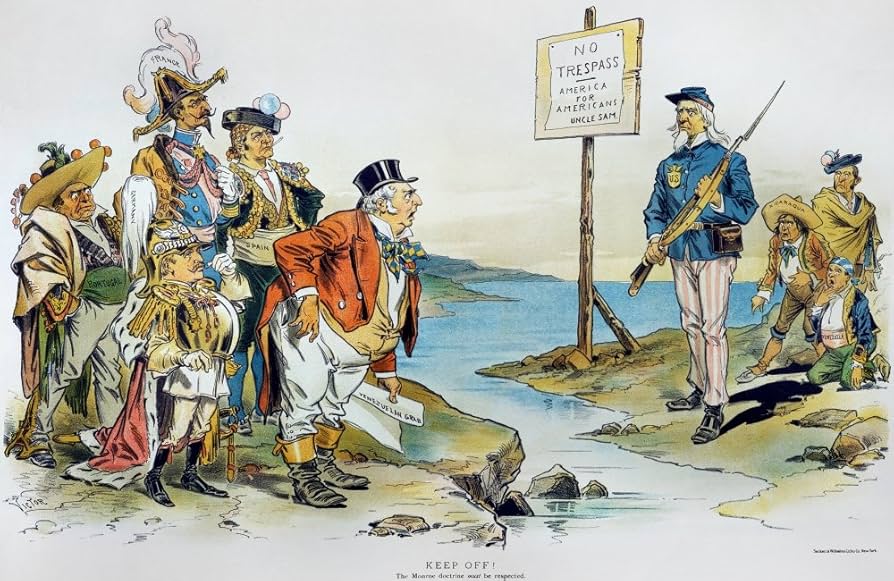
“Wherever the standard of freedom and independence, has been or shall be unfurled, there will [America’s] heart, her benedictions and her prayers be. But she goes not abroad, in search of monsters to destroy.” [1]
John Quincy Adams Speech, Independence Day, 1821
The Monroe Doctrine is back. Well, sort of. The Trump administration’s recent action in Venezuela and its invocation of a Trump Corollary to the Monroe Doctrine in the latest National Security Strategy has pundits buzzing about the latest manifestation of the United States’s assertion of control of the Western hemisphere—the “Donroe Doctrine.” [2]
But does Trump’s approach to the region really align with the Monroe Doctrine—the basis for American foreign policy for the last two hundred years?
The United States in 2026, while no longer at the pinnacle of its relative power, is hardly the fledgling republic that it was in 1823. Back then, as historian A.G. Hopkins has noted, the United States was an “honorary dominion” of Great Britain, still dependent on the Royal Navy to guarantee its security against the predations of other imperial powers. [3]
Those powers, especially Russia and the members of the Holy Alliance, posed a threat to the United States. Russia claimed territory in the Northwest. Further south, Spain threatened to reestablish control in the wake of revolutions that swept Latin America.
U.S. officials wrestled with how to meet these threats and secure American interests. Americans naturally sympathized with the revolutionaries, but they also eyed lucrative markets in the hemisphere. Secretary of State John Quincy Adams, however, privileged continental expansion. “The United States and North America are identical,” he wrote. [4] For now, America should not gaze abroad, “in search of monsters to destroy.” [5]
British officials also eyed Latin America’s markets and hoped to keep other imperial powers out of the region. Foreign Secretary Lord George Canning thus proposed a joint statement with the United States denying any European attempt to recolonize the hemisphere. Recognizing British designs and hoping to secure their commitment not to seek Cuba or Texas, even if it meant the United States pledged the same, Secretary of War John C. Calhoun argued that the United States should accept the British proposal. [6] Adams resisted, maintaining that the United States should maintain its freedom of action and, instead, make a unilateral declaration of its interests in the hemisphere.
President James Monroe eventually sided with Adams. The “Monroe Doctrine,” as it was later known, declared that “[the United States] should consider any attempt [by a European power] to extend their system to any portion of this hemisphere as dangerous our peace and safety.” [7] Monroe expected non-interference from Europe, but he also pledged that the United States would not interfere in European affairs nor its existing colonies in the region.
At its core, the Monroe Doctrine of 1823 was defensive, an attempt to turn the Great Powers against each other and buy time to build the United States’s own military and economic power.
By the middle of the 19th century, the United States was more secure and confident. By right of “Manifest Destiny,” President James Polk embarked upon a campaign of westward expansion. Polk sought all of Oregon, asserting a “clear and unquestionable” right to the territory. [8] Fearing that European designs in the West might impede the nation’s growth, he reiterated the Monroe Doctrine but extended it, warning Britain and France against interference with American expansion. Moreover, he declared, “should any such interference be attempted [the United States] will be ready to resist it at any and all hazards.” [9]
British officials, who also claimed some of the territory, were furious, and the two nations nearly came to blows before reaching a compromise that set Oregon’s boundaries to their present limits. It did, however, take two years of war to wrest away much of the Southwest from Mexico, but the United States now spanned from the Atlantic to the Pacific.
In the 1890s, another crisis involving European claims in the hemisphere provoked further reiteration of the Monroe Doctrine. Britain became engaged in a border dispute with Venezuela over control of the mouth of the Orinoco River, an important commercial passageway. Venezuelan officials cleverly attempted to leverage the Monroe Doctrine for their benefit, asking the United States for arbitration. William Scruggs, the former US minister to Venezuela, now working on its behalf, wrote “British Aggression in Venezuela, or the Monroe Doctrine on Trial,” warning that a British victory in the dispute would give them control of an important region in Latin America. [10] Members of Congress pushed the Cleveland administration to assert the Monroe Doctrine, “…peaceably if we can, forcibly if we must.” [11]
Soon after, Secretary of State Richard Olney wrote to his British counterparts, asserting the right of the United States to engage in any argument involving Latin America or the Monroe Doctrine. He claimed that British use of force would violate the doctrine’s principle of non-interference and again proclaimed US primacy: “Today the United States is practically sovereign on this continent…its fiat is law…” [12] Ultimately, the dispute was settled on terms favorable to Britain. Once again, U.S. officials had used the episode to assert American rights and interests.
Theodore Roosevelt further extended the Monroe Doctrine to justify intervention in the region. Roosevelt viewed Latin America as the United States’s sphere of influence, within which lay the Caribbean basin and its lucrative markets and materials, and perhaps most importantly, potential routes for a transoceanic canal, all essential for American power. Roosevelt wanted control over these vital areas, and he asserted a civilizational logic to justify a reinterpretation of the Monroe Doctrine. [13] In 1901, he declared that American intervention among “barbarous and semi-barbarous peoples” was “a most regrettable but necessary…duty which must be performed for the sake of the welfare of mankind,” setting the stage for the Roosevelt Corollary in 1904. [14]
In a major reinterpretation of U.S. policy, Roosevelt argued that “…the adherence of the United States to the Monroe Doctrine may force the United States, however reluctantly, in flagrant cases of such wrongdoing or impotence, to the exercise of an international police power.” [15] In doing so, he effectively extended the Monroe Doctrine to allow intervention in external and internal affairs–the political, economic, and social life of nations. The Roosevelt Corollary would serve as justification for repeated American involvement in the hemisphere.
It is perhaps Roosevelt’s “Big Stick” diplomacy and his 1904 corollary that most closely aligns with the Trump administration’s approach to the hemisphere, particularly the recent operation to remove Nicolás Maduro from power in Venezuela. Yet there are echoes of other approaches to the region beyond these more explicit manifestations of the Monroe Doctrine. In particular, there are also elements of Roosevelt’s successors’ approaches apparent in the Trump administration’s efforts to “enlist and expand” its allies and its influence in the region. [16] While the threat of force is apparent in Venezuela, and to some extent, Trump’s current designs on Greenland, the administration’s preferred approach is “commercial,” reminiscent of the “dollar diplomacy” of William Howard Taft. [17] Likewise, efforts to secure allies in the region recall a more malignant side of Franklin Roosevelt’s Good Neighbor Policy, under which the United States supported right-wing dictators in the name of stability and collective security.
Thus, the “Donroe Doctrine” hardly resembles Monroe’s original statement. Offensive rather than defensive, interventionist rather than non-interfering, involved in the external and internal affairs of the region, the United States now goes forth, in search of monsters.
Professor Susan Perlman is a historian of US foreign relations who focuses on the intersection of intelligence and foreign policy. She holds a PhD in history from American University. She is a former intelligence officer and current Georgetown professor. She is the author of Contesting France: Intelligence and U.S. Foreign Policy in the Early Cold War (Cambridge University Press, 2023), which was awarded the 2024 prize for best book in intelligence history by the International Intelligence History Association.
Endnotes
[1] John Quincy Adams, Independence Day Speech, July 4, 1821, John Quincy Adams Society, https://jqas.org/jqas-monsters-to-destroy-speech-full-text/
[2] The White House, The National Security Strategy of the United States, November 2025. https://www.whitehouse.gov/wp-content/uploads/2025/12/2025-National-Security-Strategy.pdf
[3] A.G. Hopkins, “The United States, 1783-1861: Britain’s Honorary Dominion?, Britain and the World 4, no. 2: 238, 245.
[4] John Quincy Adams, “Diary,” November 16, 1819. Massachusetts Historical Society, https://www.primarysourcecoop.org/publications/jqa/document/jqadiaries-v31-1819-11-p194–entry16.
[5] John Quincy Adams, Independence Day Speech, July 4, 1821.
[6] John Quincy Adams, “Diary”, November 7, 1823. Massachusetts Historical Society, https://www.primarysourcecoop.org/publications/jqa/document/jqadiaries-v34-1823-11-p149–entry1?redirectFromPubs=1.
[7] James Monroe, Seventh Annual Message to Congress,” December 2, 1823. National Archives, https://www.archives.gov/milestone-documents/monroe-doctrine.
[8] James K. Polk, Inaugural Address, March 4, 1845. The Miller Center, https://millercenter.org/the-presidency/presidential-speeches/march-4-1845-inaugural-address
[9] James K. Polk, First Annual Message, December 2, 1845. The Miller Center, https://millercenter.org/the-presidency/presidential-speeches/december-2-1845-first-annual-message.
[10] William Scruggs, “British Aggression in Venezuela, or The Monroe Doctrine on Trial,” 1894.
[11] Henry Cabot Lodge, “England, Venezuela, and the Monroe Doctrine,” North American Review 160, no. 463 (June 1895): 658.
[12] Richard Olney, “Mr. Olney to Mr. Bayard,” July 20, 1895. Office of the Historian, US Department of State, https://history.state.gov/historicaldocuments/frus1895p1/d527.
[13] Frank Ninkovich, “Theodore Roosevelt: Civilization as Ideology,” Diplomatic History 10, no. 3 (Summer 1986): 231.
[14] Theodore Roosevelt, “First Annual Message,” December 3, 1901. The Miller Center, https://millercenter.org/the-presidency/presidential-speeches/december-3-1901-first-annual-message
[15] Theodore Roosevelt, “Annual Message to Congress,” December 6, 1904. National Archives, https://www.archives.gov/milestone-documents/roosevelt-corollary
[16] National Security Strategy (2025), 16.
[17] National Security Strategy (2025), 16.




 Democracy & Society Journal
Leave a comment