
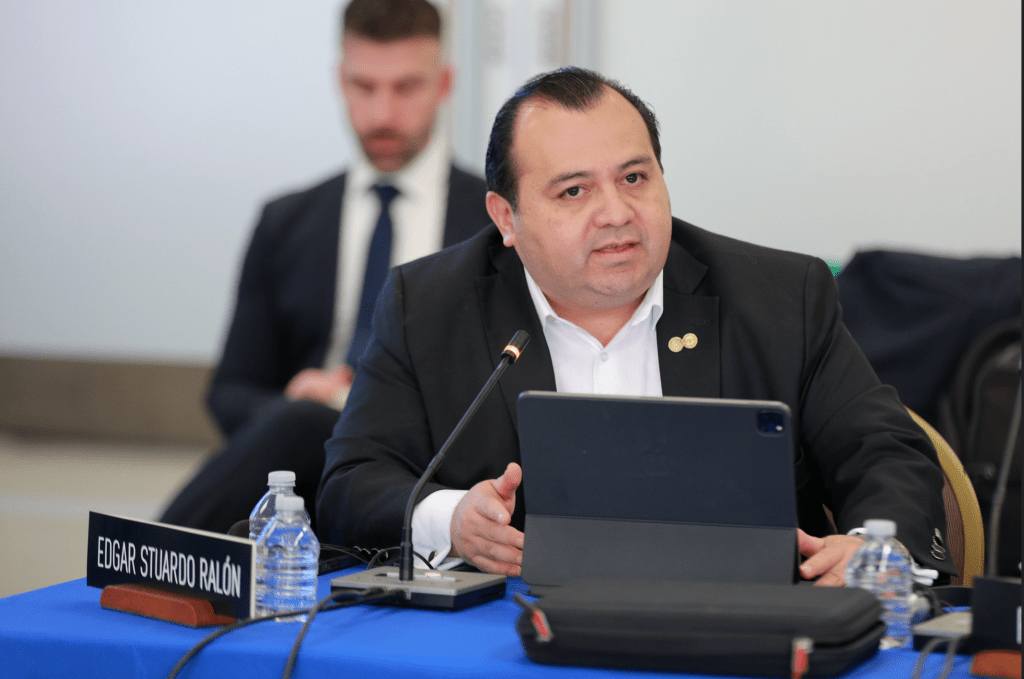
In an interview with Democracy and Society, IACHR President Edgar Ralón Orellana reviewed the state of human rights across Latin America, raising alarms about entrenched authoritarian regimes and the impact of violence and organized crime on democratic governance.
Last week, the Inter-American Commission on Human Rights (IACHR) presented its 2025 Annual Report, issuing a series of stark warnings about the state of human rights in the Americas. The document highlights persistent violations in Venezuela, Cuba, and Nicaragua, as well as the growing impact of organized crime on democratic institutions across the region.
In Venezuela, the situation remains particularly critical. Despite recent political developments, the underlying dynamics of repression remain unchanged. Human rights violations continue to be widespread, with reports of political prisoners, restrictions on civic space, and the absence of conditions for a democratic transition.
“A climate of systematic human rights violations persists,” said Edgar Stuardo Ralón Orellana, President of the IACHR, without hesitation. “It is important to recall that, in 2025, the Commission concluded that Nicolás Maduro remained in power through strategies amounting to state repression and electoral fraud. What we are seeing today is a continuation of that scenario, in which the will expressed at the ballot box was not respected.”
He stressed that political or economic adjustments alone are insufficient without a democratic transition. “The necessary conditions for the full respect of human rights are still not in place. There continue to be reports of political and conscience-based detainees, and there is no genuine civic space that would allow for the emergence of a plural movement capable of advancing democratic change.”
Despite repeated attempts, the Commission has been unable to conduct an in loco visit to the country because the Venezuelan authorities have not granted permission. Ralón Orellana argued that renewed international pressure—particularly from the United States, which has begun cautiously reengaging with Caracas—could be decisive.
“There should be a collective call for an on-site monitoring mission by the Commission,” he said. “If the goal is to move toward a democratic transition, it is essential to re-engage the instruments of international human rights law. In this context, the competent body is the Commission.”
The pattern is similar in Cuba and Nicaragua, where the institution identifies deeply entrenched authoritarian systems. “What we see in Cuba is a one-party system—a dictatorship that imprisons young people who take to the streets to demand freedom and democracy,” Ralón Orellana said. As the IACHR’s rapporteur for Cuba, he has closely monitored the country’s internal dynamics.
He also pointed to the deepening humanitarian crisis driven by economic collapse and the regime’s reliance on external sources of revenue. “The economic model has failed. And this crisis is compounded by a system in which the regime’s main source of income is no longer tourism, but Cuban medical missions.” In a recent report, the IACHR described these missions as consistent with “contemporary forms of slavery or forced labor.”
In Nicaragua, the pattern is equally severe. “The situation shows many parallels—particularly in the systematic closure of civic space,” he explained. This includes the cancellation of legal status for civil society organizations, the targeting of religious institutions, and the arbitrary revocation of nationality. “Individuals are expelled from their own country, labeled as traitors, and rendered stateless—unable to return or obtain identity documents.”
Organized Crime and the Erosion of Democratic Governance
Beyond these authoritarian regimes, the IACHR warns of a broader regional trend affecting democratic countries: the growing influence of organized crime. According to the Commission, violence is no longer confined to major urban centers but has expanded into rural and peripheral areas where the State lacks effective control.
This dynamic, Ralón Orellana explained, is not only putting individuals at risk but also undermining democratic institutions. “There are territories where the State itself lacks effective control,” he said. “In such contexts, it becomes difficult to sustain civic space and guarantee the exercise of fundamental rights.”
The scale of the crisis is reflected in the data. In 2025, the IACHR registered a 66 percent increase in requests for precautionary measures—the highest level in its history. According to Ralón Orellana, many of these cases are linked to structural vulnerability and the absence of effective state protection. “This is particularly alarming because the trend continues to rise even in the first months of 2026,” he noted.
In such environments, he added, the basic conditions for democratic life begin to collapse. “How can individuals freely express their views, exercise their rights, or pursue a life project in areas where movement is restricted, where speaking out is dangerous, and where armed groups forcibly recruit children and adolescents?”
The dilemma becomes especially visible in cases like El Salvador. Under President Nayib Bukele, the country has experienced a dramatic drop in homicide rates and overall violence. At the same time, however, the IACHR has raised serious concerns about widespread human rights violations under the prolonged state of emergency. The Commission’s position is clear. “States of emergency cannot become permanent,” Ralón Orellana warned. “They must be subject to periodic review to ensure that respect for individual rights prevails and that exceptional measures do not become normalized.”
He emphasized that El Salvador’s emergency regime—repeatedly extended without substantive reassessment—risks becoming institutionalized. The Commission, he said, is urging authorities to evaluate current security conditions and begin a gradual transition back to a framework of full constitutional rights.
Victoria Brusa is a political communication and public affairs specialist from Argentina, currently pursuing a Master’s in Democracy and Governance at Georgetown University as a 2025 Fulbright and PEO Scholar.
Before joining the program, she served as Press Director for Argentina’s Chief of Staff and the Ministry of the Interior, leading media strategy and communications at the highest levels of government. Her previous experience includes working as a press advisor in Argentina’s National Congress and on the presidential campaign of La Libertad Avanza. She also worked in the private sector as a senior account analyst at a leading PR agency, advising clients in the energy, finance, and consumer goods industries, as well as academic and international institutions.

 Democracy & Society Journal
Leave a comment