
Nick Papanicolaou, M.A. Candidate in Democracy and Governance, Georgetown University
Political scientists often describe the United Kingdom as having an ‘unwritten’ constitution. They are only half right. Britain’s constitution is written across statutes from Magna Carta (1215) to the Human Rights Act (1998), and underpinned by unwritten conventions and principles that govern the relationship between institutions including Parliament, the judiciary and the monarchy. Chief among these principles is what A.V. Dicey calls ‘Parliamentary Sovereignty’, which gives the British Parliament the power to repeal, amend or introduce any law it so wishes through simple majority vote. In sharp contrast to most democracies, the Diceyan constitution does not subject Parliament to any higher authority with the power to overrule its sovereign decisions.
The principle that nobody can bind the hands of the people’s elected Parliament is, from one standpoint, extremely democratic. But it also puts enormous power in the hands of the governing party of the day. The risk of an elected government exploiting its constitutional powers to inflict a tyranny of the (parliamentary) majority has informed a more modern ‘post-Diceyan’ school of thought. It argues that even Parliament is subject to the higher principle of ‘common law’: a concept of rights, such as habeas corpus and the right to due process, as being guaranteed not by legislation but by established judicial precedent. Some judges have already asserted their right to make decisions according to common law, even if their verdicts override existing legislation. As Lord Steyn put it when deliberating on Jackson v Attorney General (2005), ‘The supremacy of Parliament is still the general principle of our constitution. [But] It is a construct of the common law. The judges created it. And the judges may one day declare it no longer applies’. This interpretation of the constitution directly clashes with the Diceyan view of Parliamentary sovereignty. The uncodified nature of the British constitution means there is no central authority that can resolve this tension by clarifying whose interpretation of the constitution is objective correct.
For years, this friction in the British constitution has remained latent. No court has ever seen reason to invoke the principle of common law to overrule an Act of Parliament. But this is in part because successive British governments have not given them a reason to. Governments of every stripe have adhered to unwritten norms that place emphasis on principles such as individual freedom, democracy and executive moderation. Parliament’s tendency towards self-restraint has also led to an evolution in constitutional doctrine that places self-imposed limits on government power, leading to the introduction of legislation such as the Human Rights Act and the Devolution Acts. Britain has never had a Parliament that has sought to assert its authority over the basic principles of common law. But this may be because it has never been governed by a party of the radical right. That may be about to change.
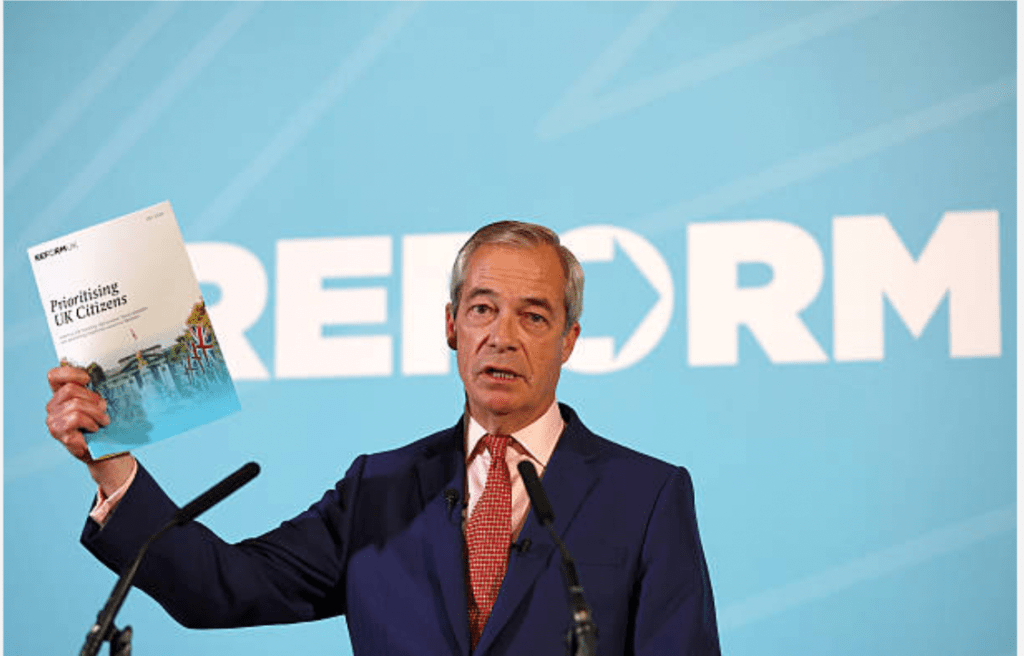
The next UK general election is not scheduled until 2029. But every day, the prospect that it will be won by either of Britain’s two historic parties recedes. Nigel Farage’s populist right party, Reform UK, leads the incumbent Labour government by around ten points in the opinion polls. A lead of this size is likely to be inflated into a significant parliamentary majority at a general election under Britain’s first past the post system, which just last year gave the incumbent Labour government a majority of 175 on just 33.7% of the vote.
Reform’s signature policies not only represent a radical assault on agreed constitutional doctrine, they threaten to put Parliament and the courts on a collision course to irreconcilable constitutional crisis. Commitments to withdraw Britain from the Refugee Convention, cancel its membership of the European Convention on Human Rights and replace the Human Rights Act with a ‘British Bill of Rights’ that would only apply to UK citizens are ostensibly designed to allow the UK to deal with the problem of irregular migration swiftly and decisively. But in practice, they also mean denying people the right to due process, canceling the right of appeal and preventing aid workers from fulfilling their responsibilities to save people from drowning as they attempt to cross the English Channel. To the extent that divisions over these policies from within Reform exist, they come from factions that are even further to the right.
Questions about whether would legislation of this kind contradicts natural law would inevitably arise. The courts might, for the first time, feel compelled to invoke the concept’s authority, while a Reform-led government would doubtless insist its actions are justified under the Diceyan concept of Parliamentary Sovereignty. The public would be stirred to pick sides, with each likely claiming the other is violating constitutional precedent. No process exists for determining how this conflict would end.
The British constitution has its merits. No Parliament is bound by decisions made by centuries-old predecessors. No ancient doctrine claims the exclusive right to sovereignty, even if said doctrines continue to form an important part of the modern constitutional order. An elected Parliament is empowered to act on the wishes of the people, and constitutional norms and precedents are allowed to evolve gently over time. But the fundamental principles of the British constitution have never been totally agreed upon. Dicey’s conception of Parliamentary Sovereignty was just his opinion. It has only worked so far because Parliament has not tried to assert its authority over common law itself.
Liberal, Conservative and Labour governments have abided by the ‘good chaps’ theory of politics, tacitly agreeing to abide by a similar set of norms. But these norms are crumbling. Reform look set to test the limits of Parliament’s constitutional power. Judges that stand in their way would likely be branded as traitors and their authority dismissed. Opposition parties may respond by decrying Reform as behaving illegitimately. Neither will be able to prove their theory of the constitution is right. Scholars often say that the British constitutional model is only possible because of the UK’s deep consensus around common law principles. This consensus is gone. If Reform do win a majority at the next election, British democracy may never look the same again.
Nick Papanicolaou is a second year masters student in the Democracy & Governance program. Originally from London, England, he completed his bachelors degree in History & Politics at the University of Cambridge before relocating to Washington, DC. His research focuses include electoral politics and the strategic responses to the rise of nationalist and populist parties across Europe and North America.