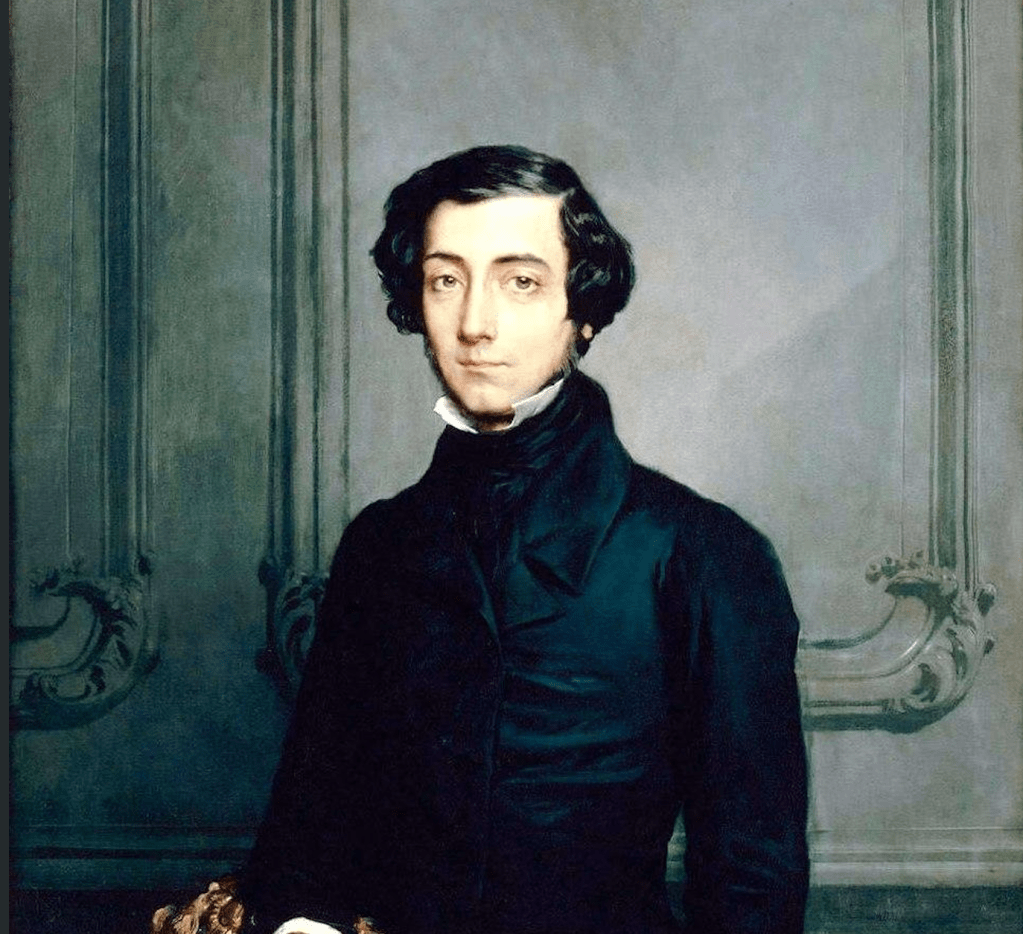
Democracy in America by Alexis de Tocqueville is a favorite of Georgetown’s faculty. Lauded as the first, and perhaps the greatest, modern sociological study, Georgetown professors ad nauseam cite Tocqueville’s analysis as foundational for understanding the relationship between civil society and democratic government. They are right to do so. Tocqueville’s work systematically examines how democracy shapes and is shaped by its citizenry. His observation that civil society associations — such as churches, advocacy groups, etc. — fuel democratic practice has become a fundamental tenet of democratic theory. Yet Tocqueville’s argument rests on an assumption that many modern defenders of democracy overlook.
Democracy in America situates its arguments within what Tocqueville takes as a necessary precondition: social equality. He observed that “the equality of conditions is the fundamental fact from which all others seem to be derived” in the world’s first thriving democracy. [1] The economic and social order of 19th-century America shocked Tocqueville, who himself was a product of elitist French society. Unlike in aristocratic Europe, Americans could plausibly imagine themselves as equal participants in the democratic project. [2] He marveled at how little distance separated Americans from those who governed them: “Public officers in the United States are commingled with the crowd of citizens; they have neither palaces, nor guards, nor ceremonial costumes.” Even more striking, American citizens “respect the office more than the officer,” regarding public authority as something exercised among equals rather than imposed by a superior class. [3]
Tocqueville called this dynamic the democratic social condition. [4] In such societies, people do not need to be literally equal in wealth or status, but they must plausibly understand themselves as equal participants in political and economic life. That perception depends on some real foundation of social and economic equality. When ordinary citizens believe that prosperity, influence, and dignity are attainable, they are more likely to organize, associate, and advocate for their interests. As Tocqueville wrote, “Associations ought, in democratic nations, to stand in lieu of those powerful private individuals whom the equality of conditions has swept away.” [5] In other words, a civil society is not the sole source of a flourishing democracy. It is, at least in part, a second-order result of citizens believing they are equal enough to act together.
Democracy in modern America, however, no longer feels equal. Wealth consolidation, the demise of manufacturing, and declining economic mobility have resulted in extreme social pessimism. [6] Americans experience these pressures alongside an epidemic of social isolation, as digitization, mass media, and secularization erode traditional spaces for human connection. [7] All of this has occurred even as America is collectively richer than ever, and political participation remains historically high. [8] The result is a distinctly Tocquevillian problem: citizens retain formal political rights and observe growing wealth while feeling that they themselves are not equal partners in national prosperity.
I am not the first to point out the connection between inequality, democracy, and Tocqueville. Scholars like Ganesh Sitaraman and Robert Putnam have thoroughly explored how modern society fails to build social and economic capital between its citizens. [9] [10] Yet these material and associational accounts leave room for the more fundamental Tocquevillian concern. Democracy depends not only on equality indicators or associational membership, but also on ordinary citizens’ belief that they themselves are politically and socially consequential.
While 19th-century America was unequal by modern standards, Tocqueville noted the broad perception that American economic and political gains were a common inheritance. [11] What mattered for citizens of Tocqueville’s America was not empirical equality quantified by arcane measures like the Gini Index. It was experiential equality — the widespread belief that prosperity and political influence were attainable rather than permanently reserved for an entrenched class of elites. Tocqueville’s America upheld men like President Andrew Jackson, taking it as an article of faith that even those born into poverty and obscurity could rise to the nation’s highest heights.
Our politics today, unfortunately, reflect a more pessimistic society. Loud voices on the left and right deny that economic and political advancement is realistic. Republicans advance the notion that the left’s monopoly on American institutions systematically marginalizes conservatives. Democrats claim that the billionaire class constitutes an impenetrable cabal exploiting and silencing the working class. Silicon Valley tech bros, who map schizophrenically onto the political spectrum, predict a ‘permanent underclass,’ dividing society into those who benefited from the AI gold rush and those who did not. These concerns clearly register with voters, who may no longer believe in or reflect Tocqueville’s depiction of a democratic social condition.
A society can be rich, participatory, and still feel undemocratic to the people living inside it. Consumer sentiment is increasingly divorced from economic metrics; democratic sentiment may be as well. [12] As Pope Leo XIV noted in his recent encyclical Magnifica Humanitas, dignity includes both the “concrete respect received from society” and “the way in which a person perceives his or her own worth and the value of life.” [13] Pope Leo is right to fear that AI and wealth consolidation are accelerating the perception that average lives are less meaningful. Over 75% of Americans believe that political institutions have been captured by the rich and powerful, and over 60% believe that AI will result in fewer jobs overall. [14]
Pope Leo’s concern that modern people perceive their lives as less meaningful is compounded by meaningful declines in economic equality and mobility. [15] That combination poses a deadly threat to democracy, as citizens begin to view themselves not as equal participants in public life, but as subjects of forces they cannot meaningfully influence. It is from this condition that populism has become politically dominant across the political spectrum. Our current societal moment bears the markers of a democratic doom loop: an undemocratic social condition fuels populism, and populist rhetoric further convinces citizens that society no longer belongs to them.
So can democracy withstand social pessimism? Academics, politicians, and even popes can propose any number of policy solutions to inequality and the digitization of society. But Tocqueville’s Democracy in America suggests the problem is more primordial. When ordinary citizens no longer believe that society belongs to them, they will not channel their democratic energies productively. We cannot forget Tocqueville’s lesson. Democratic theorists and politicians must cultivate a society with a sense of social equality rather than addressing development goals alone. Until Americans once again feel that prosperity, influence, and dignity lie within their reach, the crisis of democracy in America will remain.
Jack Gigante is a student in Georgetown’s Government Department and editor of the Democracy and Society Journal.
Endnotes
[1] Alexis de Tocqueville, Democracy in America, trans. Henry Reeve, digital ed. by Project Gutenberg, formatted and lightly modernized by William H. Gross (2019), 13, https://www.onthewing.org/user/DeTocqueville%20-%20Democracy%20in%20America.pdf.
[2] Tocqueville, Democracy in America, 36–40.
[3] Tocqueville, Democracy in America, 127.
[4] Tocqueville, Democracy in America, 36.
[5] Tocqueville, Democracy in America, 316.
[6] Board of Governors of the Federal Reserve System, “Distribution of Household Wealth in the U.S. since 1989,” Distributional Financial Accounts, https://www.federalreserve.gov/releases/z1/dataviz/dfa/distribute/chart/; Katelynn Harris, “Forty Years of Falling Manufacturing Employment,” Beyond the Numbers: Employment & Unemployment 9, no. 16 (U.S. Bureau of Labor Statistics, November 2020), https://www.bls.gov/opub/btn/volume-9/forty-years-of-falling-manufacturing-employment.htm; Opportunity Insights, “National Trends: The American Dream Is Fading,” https://opportunityinsights.org/national_trends/.
[7] Office of the U.S. Surgeon General, Our Epidemic of Loneliness and Isolation: The U.S. Surgeon General’s Advisory on the Healing Effects of Social Connection and Community (2023), https://www.hhs.gov/sites/default/files/surgeon-general-social-connection-advisory.pdf; Robert D. Putnam, Bowling Alone: The Collapse and Revival of American Community (New York: Simon & Schuster, 2000), 216–46; Pew Research Center, “Religious ‘Nones’ in America: Who They Are and What They Believe,” January 24, 2024, https://www.pewresearch.org/religion/2024/01/24/religious-nones-in-america-who-they-are-and-what-they-believe/.
[8] World Bank, “United States,” https://data.worldbank.org/country/united-states; Drew DeSilver, “Voter Turnout, 2018–2022,” Pew Research Center, July 12, 2023, https://www.pewresearch.org/politics/2023/07/12/voter-turnout-2018-2022/; Pew Research Center, “Section 5: Political Engagement and Activism,” June 12, 2014, https://www.pewresearch.org/politics/2014/06/12/section-5-political-engagement-and-activism/.
[9] Ganesh Sitaraman, The Crisis of the Middle-Class Constitution: Why Economic Inequality Threatens Our Republic (New York: Knopf, 2017), 4; Ganesh Sitaraman, “Book Excerpt: ‘The Crisis of the Middle-Class Constitution,’” BillMoyers.com, March 24, 2017, https://billmoyers.com/story/book-excerpt-the-crisis-of-the-middle-class-constitution/.
[10] Putnam, Bowling Alone.
[11] Tocqueville, Democracy in America, 40.
[12] Kyla Scanlon, “The Vibecession: The Self-Fulfilling Prophecy,” Kyla’s Newsletter, June 30, 2022, https://kyla.substack.com/p/the-vibecession-the-self-fulfilling.
[13] Pope Leo XIV, Magnifica Humanitas, May 15, 2026, sec. 52, https://www.vatican.va/content/leo-xiv/en/encyclicals/documents/20260515-magnifica-humanitas.html.
[14] Taylor Orth, “Distrust of Elites, Experts, and the Establishment Is Widespread among Americans,” YouGov, December 30, 2025, https://yougov.com/en-us/articles/53800-distrust-elites-experts-establishment-widespread-among-americans-december-26-29-2025-economist-yougov-poll; Stanford Institute for Human-Centered Artificial Intelligence, “Public Opinion,” The 2026 AI Index Report, https://hai.stanford.edu/ai-index/2026-ai-index-report/public-opinion.
[15] Pope Leo XIV, Magnifica Humanitas, sec. 52; Board of Governors of the Federal Reserve System, “Distribution of Household Wealth in the U.S. since 1989”; Opportunity Insights, “National Trends.”