By Victoria Brusa (*). The United Nations is choosing a successor to Secretary-General António Guterres, who is set to step down on December 31 at the end of his second five-year term [1]. After months of negotiations, however, the United States and China still cannot agree on who should lead the organization during a tumultuous period for diplomacy. As a result, the selection process could face a deadlock.
The two superpowers currently support different candidates. The United States backs Argentine diplomat Rafael Grossi, who leads the International Atomic Energy Agency (IAEA) [2]. In that role, he has handled major diplomatic and security issues, including the nuclear safety crisis at the Zaporizhzhia Nuclear Power Plant in Ukraine [3] and renewed engagement with Syrian authorities over the remnants of former dictator Bashar al-Assad’s clandestine nuclear activities [4].
China, by contrast, supports Rebeca Grynspan, the current head of the United Nations Conference on Trade and Development (UNCTAD) from Costa Rica [2]. Grynspan also has experience managing acute diplomatic crises. She was a key figure behind the Black Sea Grain Initiative and the Istanbul agreements among Turkey, Russia, and Ukraine [5], which reopened Black Sea shipping lanes and allowed the safe export of more than 33 million tons of Ukrainian grain after the war began [6].
Other candidates who are still in the running are Carolyn Rodrigues Birkett, current Guyana Ambassador to the United Nations; Macky Sall, former President of Senegal; Olara Otunnu, former Foreign Affairs Minister of Uganda, and María Fernanda Espinosa, former President of the United Nations General Assembly and former Minister of Foreign Affairs of Ecuador [7].
Several Security Council members, along with other countries, have expressed support for a woman leading the organization for the first time in its 81-year history. At their summit in New Delhi in September [8], the BRICS group — Brazil, Russia, India, China, and South Africa — released a statement noting that “no woman has ever been elected for the role of secretary-general, and only one national from Latin America and the Caribbean, and only two nationals from Africa and Asia each have ever occupied this position.”
Under the UN Charter, the secretary-general is appointed by the General Assembly on the recommendation of the Security Council [9], which in practice makes the decision. The Council has 15 members. Five are permanent and hold veto power: the United States, Russia, China, the United Kingdom, and France, known as the P5. The other ten are elected by the General Assembly for two-year terms, and this year they are Bahrain, Colombia, the Democratic Republic of the Congo, Denmark, Greece, Latvia, Liberia, Pakistan, Panama, and Somalia [10]. Council members first hold a series of closed-door “straw polls,” in which each country marks every candidate as “encouraged,” “discouraged,” or “no opinion expressed.” [11] To be recommended, a candidate needs at least nine votes and no veto from the P5 [12].
So far, no candidate has cleared that second hurdle. In the most recent straw poll, held on October 7 [7], Grynspan received nine ‘encourage’ votes and six ‘discourage.’ Grossi came in second with six ‘encourage,’ seven ‘discourage,’ and two ‘no opinion,’ while Rodrigues Birkett fell to third with five ‘encourage,’ nine ‘discourage,’ and one ‘no opinion.’
The deadlock comes at a critical moment for international organizations and the principle of multilateralism. Last month, during the 81st session of the UN General Assembly (UNGA) in New York, numerous leaders emphasized that the organization’s credibility has declined and that its current ability to fulfill the objectives set out in the UN Charter is limited. Brazil’s Lula said the UN’s credibility “has never been lower” [13]; Türkiye’s Erdoğan argued that it “has been made unable” [14] to fulfill its mission; Argentina’s Milei dismissed it as “useless” [15]; and Kenya’s Ruto and Ghana’s Mahama warned that an unreformed Security Council threatens “the legitimacy, credibility, and survival of the United Nations.” [16]
The United States government has been an active driver of this trend, as reflected in the Trump administration’s withdrawal from 66 international bodies, 31 of them within the UN system [17], including the World Health Organization (WHO) [18], the United Nations Educational, Scientific and Cultural Organization (UNESCO) [19], and the Human Rights Council [20]. The current White House has also repeatedly expressed interest in creating a new organization to replace the UN [21], and the Board of Peace—the initiative Trump launched to administer a transition in Gaza—has been interpreted as a clear step in that direction.
On Friday, October 16, the Security Council will hold its sixth straw poll [7], a vote that could clarify whether the selection process is moving toward consensus or a prolonged deadlock. Because reports suggest the poll will use colored ballots, the results should reveal not only where each candidate stands, but also how deep divisions are within the P5 members.
If neither Grossi nor Grynspan gets the needed votes, other countries will likely begin introducing their own candidates. Turkey’s Erdoğan is already pushing its former foreign affairs minister, Feridun Sinirlioglu [22], while the United Arab Emirates (UAE) briefly introduced its minister of state, Lana Nusseibeh [23], although that candidacy appears to have ended before it fully began. Similarly, Trump is said to have been exploring a new candidate: Bulgarian diplomat Nickolay Mladenov, currently the leader of the Board of Peace [24].
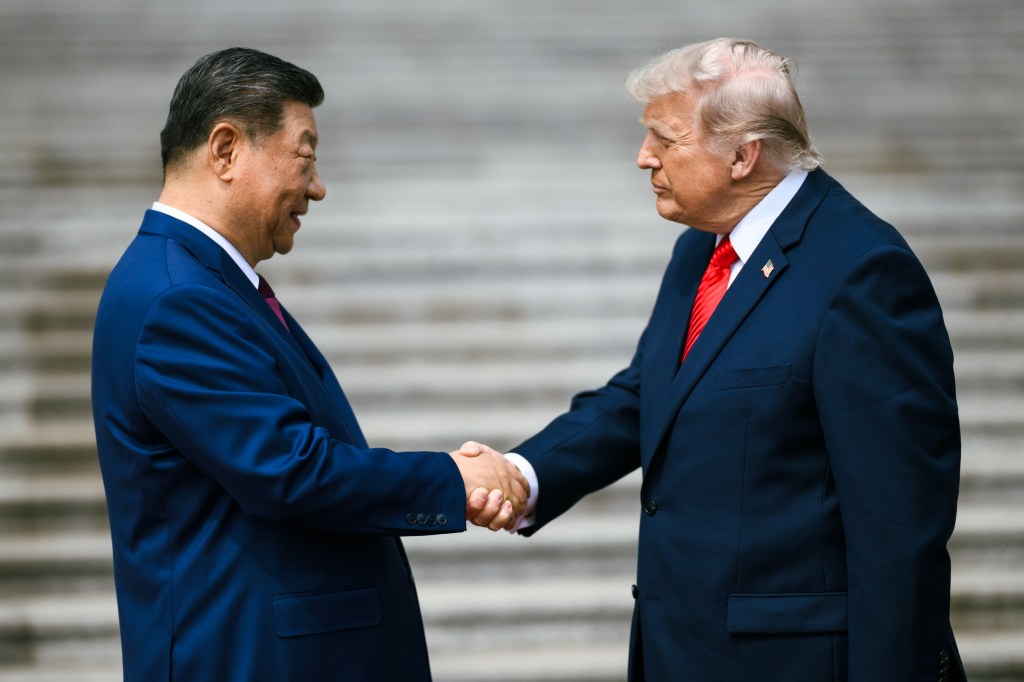
Numerous last-minute and unexpected candidates could still be put forward for discussion. But a winner can emerge only after the United States and China reach an agreement, which might involve trade-offs across a wide range of issues, including trade and AI. Xi Jinping’s visit to the White House last September did not advance a UN deal [25], although talks are still ongoing.
(*) Victoria Brusa is a Fulbright Scholar, currently pursuing an MA in Democracy and Governance at Georgetown University. She serves as Democracy and Society Senior Editor.
References
[1] Security Council Report. “Appointment of the Next UN Secretary-General: Joint Letter from the Presidents of the Security Council and the General Assembly.” What’s In Blue, November 25, 2025. https://www.securitycouncilreport.org/whatsinblue/2025/11/appointment-of-the-next-un-secretary-general-joint-letter-from-the-presidents-of-the-security-council-and-the-general-assembly.php
[2] Patrick, Igor. “China Set to Decide if Costa Rican or Guyanese Diplomat Becomes First Woman UN Chief.” South China Morning Post, September 26, 2026. https://www.scmp.com/news/china/article/3368869/china-set-decide-if-costa-rican-or-guyanese-diplomat-becomes-first-woman-un-chief
[3] International Atomic Energy Agency. “Nuclear Safety, Security and Safeguards in Ukraine.” IAEA. Accessed October 11, 2026. https://www.iaea.org/topics/response/nuclear-safety-security-and-safeguards-in-ukraine
[4] The National. “IAEA and Syria Hail Progress on Resolving Assad’s Nuclear Secrets.” The National, August 18, 2026. https://www.thenationalnews.com/news/mena/2026/08/18/iaea-and-syria-hail-progress-on-resolving-assads-nuclear-secrets/
[5] UN Trade and Development. “UN Trade and Development Chief Rebeca Grynspan Named Negotiator of the Year.” UNCTAD, May 31, 2025. https://unctad.org/news/un-trade-and-development-chief-rebeca-grynspan-named-negotiator-year
[6] Office of the UN Coordinator for the Black Sea Grain Initiative. “Operational Update, 15 July 2023.” United Nations Geneva, July 17, 2023. https://www.ungeneva.org/en/news-media/press-release/2023/07/operational-update-office-un-coordinator-black-sea-grain
[7] Banjo, Damilola. “Big Shakeup in Latest Security Council Votes on UN SecGen Race.” PassBlue, October 7, 2026. https://passblue.com/2026/10/07/big-shakeup-in-latest-security-council-votes-on-un-secgen-race/
[8] BRICS. “New Delhi Declaration: Building for Resilience, Innovation, Cooperation and Sustainability.” XVIII BRICS Summit, New Delhi, September 12, 2026. https://www.pmindia.gov.in/en/news_updates/brics-new-delhi-declaration-building-for-resilience-innovation-cooperation-and-sustainability-september-12-2026/
[9] United Nations. Charter of the United Nations, Chapter XV, Article 97. 1945. https://www.un.org/en/about-us/un-charter/chapter-15
[10] United Nations Security Council. “Current Members.” United Nations. Accessed October 11, 2026. https://main.un.org/securitycouncil/en/content/current-members
[11] Congressional Research Service. “United Nations Issues: Appointing the UN Secretary-General.” IF10454, updated February 18, 2026. https://www.everycrsreport.com/files/2026-02-18_IF10454_9d7e701c85bfa9046aaa38f30e34ba409e6e982f.html
[12] United Nations. Charter of the United Nations, Chapter V, Article 27. 1945. https://www.un.org/en/about-us/un-charter/chapter-5
[13] Xinhua. “Brazil’s Lula Warns of UN Credibility Crisis, Urges Multilateralism.” Xinhua, September 23, 2026. https://english.news.cn/20260923/1e362551a92740eab4157651a5f72449/c.html
[14] Utucu, Sait Burak. “Erdoğan Tells UN That Europe Cannot Be Safe Without Turkey.” Euronews, September 23, 2026. https://www.euronews.com/2026/09/23/erdogan-urges-un-to-abolish-security-council-veto-power-ahead-of-general-assembly-address
[15] Deconinck, Carl. “Milei Tells UN It Has Become a ‘Useless Organisation’ Feeding ‘Fatally Arrogant Parasites’.” Brussels Signal, September 24, 2026. https://brusselssignal.eu/2026/09/milei-tells-un-it-has-become-a-useless-organisation-feeding-fatally-arrogant-parasites/
[16] Aliyu, Mubarak. “UNGA81: Why Has Africa’s Security Council Reform Push Remained Unresolved?” Al Jazeera, September 26, 2026. https://www.aljazeera.com/news/2026/9/26/unga81-why-has-africas-security-council-reform-push-remained-unresolved
[17] The White House. “Fact Sheet: President Donald J. Trump Withdraws the United States from International Organizations that Are Contrary to the Interests of the United States.” January 7, 2026. https://www.whitehouse.gov/fact-sheets/2026/01/fact-sheet-president-donald-j-trump-withdraws-the-united-states-from-international-organizations-that-are-contrary-to-the-interests-of-the-united-states/
[18] Executive Order 14155. “Withdrawing the United States From the World Health Organization.” January 20, 2025. https://www.govinfo.gov/link/cpd/executiveorder/14155
[19] Associated Press. “Trump Administration Withdraws from UNESCO Again, Only 2 Years After US Rejoined.” The Boston Globe, July 22, 2025. https://www.bostonglobe.com/2025/07/22/nation/unesco-united-nations-withdrawal-israel-trump/
[20] Executive Order 14199. “Withdrawing the United States From and Ending Funding to Certain United Nations Organizations and Reviewing United States Support to All International Organizations.” February 4, 2025. https://www.govinfo.gov/link/cpd/executiveorder/14199
[21] Bussey, Emma. “Trump Floats ‘Board of Peace’ to Replace UN, Signals Major Global Power Shift.” Fox News, January 20, 2026. https://www.foxnews.com/world/trump-floats-board-peace-replace-un-signals-major-global-power-shift
[22] Associated Press. “Turkiye Is Considering Nominating Former Foreign Minister for Top United Nations Job.” Arab News, October 2, 2026. https://www.arabnews.com/middle-east/turkiye-is-considering-nominating-former-foreign-minister-for-top-united-nations-job-3004309
[23] Salmanli, Ulviyya. “UAE Names Lana Nusseibeh as UN Secretary-General Candidate.” News.az, July 3, 2026. https://news.az/news/uae-names-lana-nusseibeh-as-un-secretary-general-candidate
[24] Abdeen, Ahmed. “Exclusive: Washington Floats Mladenov as Candidate for UN Secretary-General.” The Pundit, June 23, 2026. https://thepundit.org/2026/06/23/exclusive-washington-floats-mladenov-as-candidate-for-un-secretary-general/
[25] Lindsay, James M. “Xi Jinping Visits the White House.” Council on Foreign Relations, September 23, 2026. https://www.cfr.org/articles/xi-jinping-visits-the-white-house