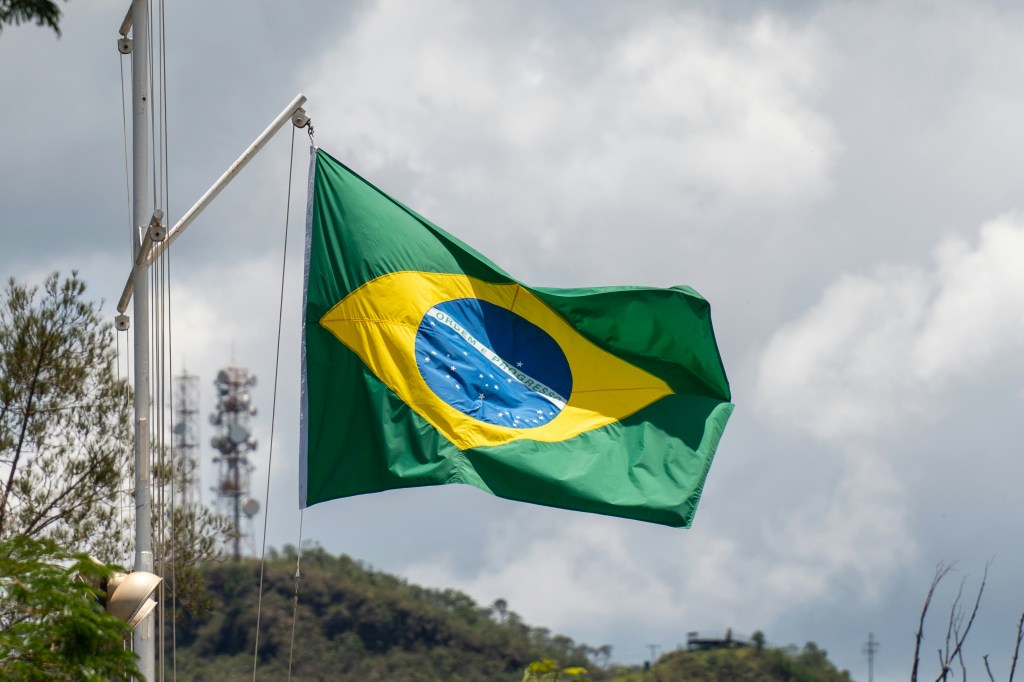
By Andeirson da Matta Barbosa (*). The rhetoric of virtue has become a strategy in contemporary politics. In Brazil, political actors invoke love of country, national symbols, and collective identity, even when their conduct points in profoundly different directions.
This issue is particularly relevant in polarized societies, where political language can influence how citizens interpret events and decide whom to support.
This October, Brazil is holding its 2026 presidential election, marked by a confrontation between two political forces with distinct orientations. On one side is the Workers’ Party (PT), a progressive party whose public policies emphasize social assistance programs and a commitment to reducing social inequalities; on the other is the Liberal Party (PL), a representative of Brazil’s conservative right.
The Liberal Party’s presidential candidate is Flávio Bolsonaro, son of former president Jair Bolsonaro (2019–2022). His economic outlook resembles the policies advocated by Javier Milei in Argentina, particularly reducing the size of government and public spending, which could mean an administration with a less extensive social assistance agenda.1
The Bolsonaro family, as well as members of the Liberal Party, have long called themselves “patriots,” adopting anti-establishment and anti-corruption rhetoric, frequently associating corruption with the Workers’ Party, the party of Brazil’s current president, Luiz Inácio Lula da Silva. Lula served two terms from 2003 to 2010, returned to office in 2023 for a third term, and is now seeking a fourth.
The association of the Workers’ Party with corruption gained strength through investigations conducted under Operation Car Wash (Lava Jato).2 Launched in 2014, the operation investigated money laundering and a bribery scheme involving the state-controlled oil company Petrobras, construction companies, and political figures. In that context, Lula was prosecuted in 2016, convicted in 2017 of passive corruption and money laundering, and imprisoned in April 2018; he was released in November 2019. Prosecutors alleged that the construction company OAS had provided him with a renovated three-story apartment in Guarujá, on the coast of São Paulo state, as an illicit benefit linked to Petrobras contracts.
However, Brazil’s Supreme Federal Court later found that then-judge Sergio Moro, the federal trial judge who presided over the case in Curitiba, had been biased in conducting the criminal proceedings concerning the Guarujá triplex apartment,3 violating the fundamental right to be tried by an impartial judge.4,5
On that occasion, the Supreme Court identified circumstances that compromised Moro’s impartiality, including conduct incompatible with the necessary separation between the functions of prosecution and adjudication. The decisions issued by Moro in the proceedings were annulled, reaffirming that fighting corruption does not justify setting aside the fundamental guarantees of due process.
Meanwhile, members of the Liberal Party, the political camp that presents itself as a defender of patriotism, morality, and integrity in public administration, have also become subjects of investigations into suspected misuse of public resources for private purposes.
Federal Police investigations, conducted under Supreme Federal Court supervision and reported by the press, point to possible irregularities involving Banco Master, a Brazilian private financial institution, and the financing of Dark Horse, a film portraying the trajectory of former president Jair Bolsonaro.6
The case involves allegations of corruption, money laundering, and possible misuse of public resources. According to press reports, the Federal Police are investigating the origin and destination of funds connected to the film’s financing, as well as possible diversion of parliamentary budget amendments linked to entities associated with the film’s production company.7
The inquiries also raise questions about financial transactions involving Banco Master, an institution implicated in broader investigations into financial irregularities.
The purpose is not to prejudge Flávio Bolsonaro’s guilt, but to highlight that the investigations point to his alleged involvement in the scandal surrounding the financing of Dark Horse. This raises a contradiction between his public commitment to morality and fighting corruption and his alleged involvement in practices similar to those he condemns in his political opponents.
Beyond this recent case, episodes following the 2022 presidential election raised serious questions about the relationship between members of the Bolsonaro movement and representative democracy and Brazilian institutions.
Following Jair Bolsonaro’s defeat in the 2022 presidential election, his political allies challenged the legitimacy of the result. In 2025, his son Eduardo Bolsonaro sought U.S. sanctions against Brazilian officials amid criminal proceedings against his father and publicly claimed credit for influencing tariffs on Brazilian goods.8,9 Seeking foreign pressure on Brazil’s judiciary and economy to advance family political interests calls into question the consistency between patriotic rhetoric and respect for national sovereignty.
The invasion of the headquarters of Brazil’s three branches of government in Brasília on January 8, 2023, also deserves attention, including the Palácio do Planalto, the National Congress, and the Supreme Federal Court. The destruction of works of art and public property represented an attack on democratic institutions and part of Brazil’s historical and cultural heritage.10
Thus, certain forms of conduct in Brazilian politics appear incompatible with patriotism. Patriotic language and anti-corruption rhetoric can become a moral cover for choices that do not consistently uphold the principles they invoke.
The first round of Brazil’s 2026 presidential election adds another dimension to this discussion: the investigations and allegations examined here did not prevent Flávio Bolsonaro from receiving substantial electoral support and advancing to the runoff.11
A vote alone does not show that a candidate’s supporters are indifferent to corruption. However, when individuals who call themselves patriots treat allegations against opponents as sufficient grounds to reject them, while minimizing comparable evidence against allies or seeking to shield them from the same scrutiny, a contradiction emerges between rhetoric and practice. The comparison is between the outrage over Lava Jato that the Bolsonaro movement used against Lula and the Workers’ Party, and the willingness of those same supporters to minimize allegations involving Flávio Bolsonaro and allied PL figures. The contradiction lies in applying different standards of scrutiny to opponents and allies, not in treating an investigation as proof of guilt.
In pluralistic societies, love of country can sustain democratic coexistence only if it does not become an instrument for mobilizing passions against fellow citizens. A political group cannot establish its patriotism simply by repeating the word, displaying a flag, or claiming to speak for the nation. Patriotism is a relationship with a political community, shaped over time, and requires respect for shared liberty, democratic institutions, cultural heritage, and the public interest.12
When a movement uses patriotic language while undermining these commitments, the problem goes beyond hypocrisy. It is a semantic displacement: a word historically associated with commitment to the national community comes to function as an instrument for morally legitimizing political practices that may contradict the very values it represents.
In this context, the rhetoric of virtue emerges: the appropriation of morally respected values to confer an appearance of legitimacy on political discourse and conduct whose consistency with those same values must be critically scrutinized.
(*) Andeirson da Matta Barbosa holds a master’s degree in Constitutionalism and Democracy from the Faculdade de Direito do Sul de Minas, Brazil, and postgraduate qualifications in Public Law and Criminal Sciences. He is an author and co-author of legal books, most recently the second edition of Epistemological Reflections (Reflexões Epistemológicas). His opinion writing has appeared in O Estado de S. Paulo, a major Brazilian national newspaper, and his legal articles have been published in specialized legal journals. He also passed competitive public service examinations for legal analyst positions at the Ministério Público Estadual (State Public Prosecutor’s Office) in 2007 and the Ministério Público Federal (Federal Public Prosecutor’s Office) in 2008, as well as the Brazilian Bar Examination (OAB).
References
- Fundação Perseu Abramo. (2026, September 21). Grupo de Flávio Bolsonaro defende “modelo Milei” para o Brasil com privatizações e “revogaço” de leis [Flávio Bolsonaro’s political group advocates a Milei-style economic model for Brazil, including privatizations and sweeping regulatory repeals]. https://fpabramo.org.br/grupo-de-flavio-bolsonaro-defende-modelo-milei-para-o-brasil-com-privatizacoes-e-revogaco-de-leis/
- Projeto Comprova. (2022, October 19). O que foi a Operação Lava Jato [What was Operation Car Wash?]. CNN Brasil. https://www.cnnbrasil.com.br/nacional/o-que-foi-a-operacao-lava-jato/
- Chagas, P. V. (2018, January 24). Entenda o caso triplex em que Lula foi condenado [Understanding the triplex case in which Lula was convicted]. Agência Brasil. https://agenciabrasil.ebc.com.br/politica/noticia/2018-01/entenda-o-caso-triplex-em-que-lula-foi-condenado
- Supremo Tribunal Federal (Brazil). (2021, April 15). STF confirma anulação de condenações do ex-presidente Lula na Lava Jato [Supreme Court confirms the annulment of former President Lula’s convictions in Operation Car Wash]. https://portal.stf.jus.br/noticias/verNoticiaDetalhe.asp?idConteudo=464261&ori=1
- Supremo Tribunal Federal (Brazil). (2021, June 23). STF confirma suspeição de Sergio Moro na ação do triplex do Guarujá [Supreme Court confirms Sergio Moro’s lack of impartiality in the Guarujá triplex case]. https://portal.stf.jus.br/noticias/verNoticiaDetalhe.asp?idConteudo=468086&ori=1
- BBC News Brasil. (2026). Flávio Bolsonaro e ‘Dark Horse’: 7 perguntas para entender inquérito — e o que falta ser esclarecido [Flávio Bolsonaro and ‘Dark Horse’: 7 questions to understand the inquiry, and what remains to be clarified]. https://www.bbc.com/portuguese/articles/crr4jg9pveeo
- Soares, J. (2026, October 9). PF aciona MJ por cooperação com EUA para rastrear dinheiro de “Dark Horse” [Federal Police ask the Justice Ministry for cooperation with the U.S. to trace “Dark Horse” money]. CNN Brasil. https://www.cnnbrasil.com.br/blogs/jussara-soares/politica/pf-aciona-mj-por-cooperacao-com-eua-para-rastrear-dinheiro-de-dark-horse/
- G1. (2025, August 14). Eduardo Bolsonaro diz que EUA devem impor novas tarifas ao Brasil e que mulher de Moraes pode sofrer sanção [Eduardo Bolsonaro says the U.S. should impose new tariffs on Brazil and that Moraes’s wife may face sanctions]. https://g1.globo.com/politica/noticia/2025/08/14/eduardo-bolsonaro-diz-que-eua-devem-impor-novas-tarifas-ao-brasil-e-que-mulher-de-moraes-pode-sofrer-sancao.ghtml
- G1. (2026, July 13). Eduardo Bolsonaro diz que lei Magnitsky contra Moraes deve ser restabelecida [Eduardo Bolsonaro says Magnitsky Act sanctions against Moraes should be reinstated]. https://g1.globo.com/politica/noticia/2026/07/13/eduardo-bolsonaro-diz-lei-magnitsky-contra-moraes-deve-ser-restabelecida.ghtml
- Ricupero, B. (2024, January 8). O que foi o 8 de janeiro? [What was January 8?]. Jornal da USP, University of São Paulo. https://jornal.usp.br/artigos/o-que-foi-o-8-de-janeiro/
- BBC News Brasil. (2026). Os gráficos que explicam como Flávio Bolsonaro chegou à frente de Lula no 1º turno [The charts that explain how Flávio Bolsonaro finished ahead of Lula in the first round]. https://www.bbc.com/portuguese/articles/crq8nx1qq8j4o
- Viroli, M. (1997). Por amor à pátria: Um ensaio sobre patriotismo e nacionalismo [For love of country: An essay on patriotism and nationalism]. Companhia das Letras.