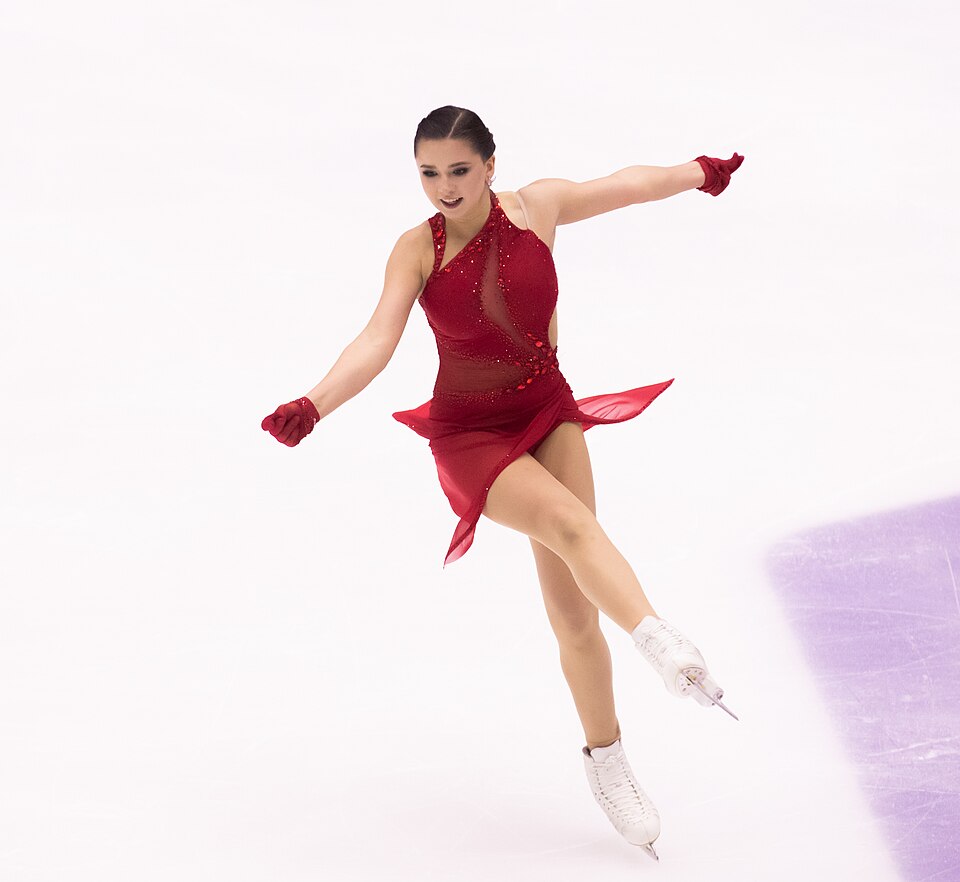
By Sophie Cope (*). Is figure skating a human right? This question struck many skating fans in early September 2026, when the European Court of Human Rights (ECHR) registered a complaint from the disgraced Russian figure skater Kamila Valieva [1]. Valieva was the center of a doping scandal that rocked the 2022 Beijing Olympics and has been unable to reenter international competition ever since. She previously faced two barriers to international competition: a four-year suspension imposed by the Court of Arbitration for Sport for a 2021 doping violation and a blanket ban on Russian and Belarusian athletes adopted by the International Skating Union (ISU) following Russia’s invasion of Ukraine [2, 3]. When the ISU established a pathway for neutral athlete participation in 2026, however, it determined that Valieva did not meet its criteria and denied her neutral-athlete status.
As Valieva continues to contest these restrictions, her case reveals a striking tension at the intersection of sport, nationalism, and international law. For years, Russian officials, media organizations, and fans lauded Valieva as a symbol of national sporting excellence. Before the European Court of Human Rights, however, she appears not as a national symbol but as an individual claimant seeking protection under a liberal human rights framework. If Olympic athletes function as vessels for national aspirations, when are they political symbols and when are they individuals entitled to legal protection?
Figure Skating as a Political Site: The Olympics and Russian National Prestige
The sport of figure skating is a political site, and the setting of the Olympics magnifies the political interpretations of and projections upon the athlete. Toby Rider and Matthew P. Llewellyn’s analysis of the Olympics as a political venue declares that “the festival remains a magnet for nationalist politics and propaganda… the Games serve as a platform for inculcating national feelings and reaffirming national identities based on conceptions of the nation-state” [4]. Likewise, in her analysis of figure skating and national narratives, Chuyun Oh declares the athletic body to be “a platform where societal ideologies and stereotypes are projected, reinforced, and/or reconstructed” [5]. The body of the Olympic figure skater can be considered a platform for perceptions of national performance, in which “an athlete[‘s] victory is shared by the nation, as is a defeat” [4]. These nationalistic perceptions are particularly salient in Russia, where figure skating represents “the personification of the nation, part of Russian culture, and an element of national heritage” [6].
Russia’s nationalistic sporting culture esteems sporting prowess on the international stage as a reflection of national superiority – so much so that the state orchestrated a massive doping program involving athletes, coaches, sporting officials, and laboratory personnel that was exposed in the aftermath of the 2014 Sochi Olympics [7]. According to investigators, laboratory officials secretly swapped athletes’ tainted urine samples for clean ones through a covert operation designed to conceal positive doping tests and bolster Russia’s medal count [7]. As a result of this scandal, Russian athletes were prohibited from competing under the Russian flag or hearing their national anthem at the 2018 Winter Olympics, 2021 Summer Olympics, and 2022 Winter Olympics [8]. When Valieva arrived in Beijing, she did so both as the favorite for Olympic gold and a representative of a sporting system under intense international scrutiny.
However, the 2022 Games were not the apotheosis that many anticipated. Although Valieva was not implicated in the Sochi-era doping scheme, she soon became embroiled in a new doping controversy of her own: during the Beijing Olympics, officials announced that a sample she had provided at the December 2021 Russian National Championships had tested positive for the banned substance trimetazidine [9]. The Court of Arbitration for Sport made a much-criticized ad-hoc ruling that permitted Valieva to compete in the women’s singles event [10]. Under intense media pressure, the skater made an uncharacteristic series of stumbles in her free program and missed the Olympic podium by one spot.
The circumstances surrounding Valieva’s doping violation further complicate her position within this debate. Her status as a minor at the time of her positive test fueled arguments that she may have been failed not only by arbitral institutions such as CAS, but by the Russian sporting system itself [11]. Valieva is therefore both a symbol of national prestige and a potential victim of the structures that produced her success.
The Aftermath of the 2022 Beijing Olympics
Despite her disappointing result, Russian media lauded Valieva as a national hero and positioned her as an innocent victim of Western cruelty. For instance, the Russian Ministry of Defense released a video of a young female skater besieged by menacing cloaked specters who disperse when the Stavropol Presidential Cadet School guards the skater [12].
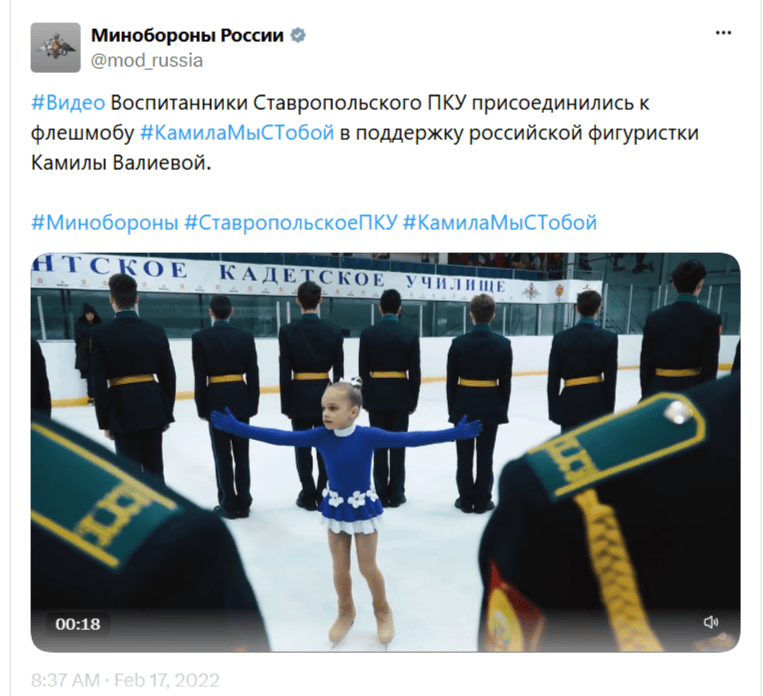
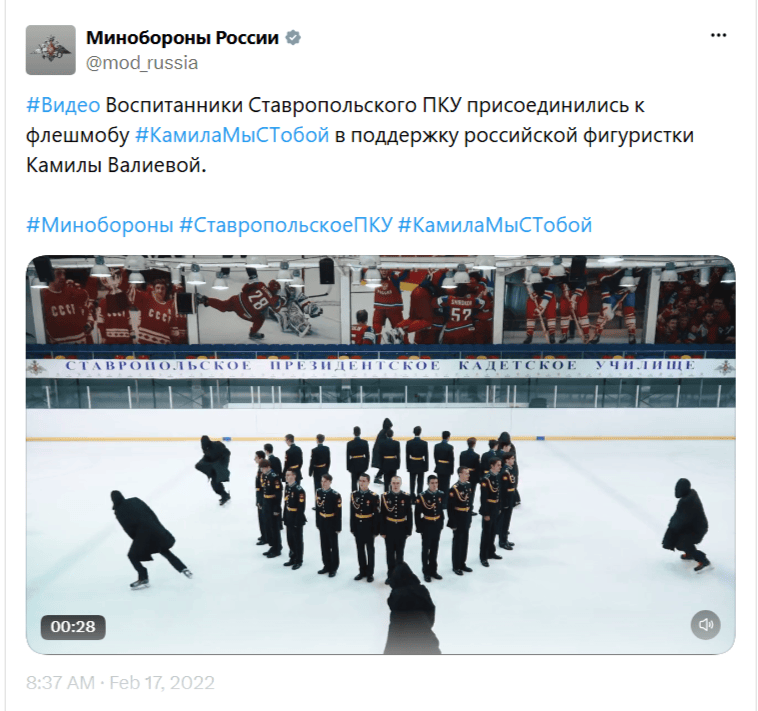
Figure 1: Members of the Stavropol Presidential Cadet School guard a young female skater from cloaked specters. Russian Ministry of Defense (@mod_russia). “#Video Cadets of the Stavropol Presidential Cadet School (PKU) joined the #KamilaWeAreWithYou flash mob in support of Russian figure skater Kamila Valieva. #MinistryOfDefense #StavropolPKU #KamilaWeAreWithYou.” X, February 17, 2022, https://x.com/mod_russia/status/1494304905686835202?s=20&t=QClWFKkNsL-ZKoBwlw0A_Q
Vladimir Putin himself disavowed Valieva’s doping allegations, granting her the Order of Friendship and remarking that “the suspension of athletes from Russia and Belarus not only directly violated the fundamental principles of sport, but their most basic human rights were … openly, cynically violated” [13, 14]. Valieva’s participation in this ceremony earned the consternation of International Olympic Committee (IOC) President Thomas Bach, who claimed that her presence was “misused for political purposes” [15]. Unperturbed, Valieva pinned the photo of her standing with Putin on her Instagram account, where it would remain until September 2026 [16].
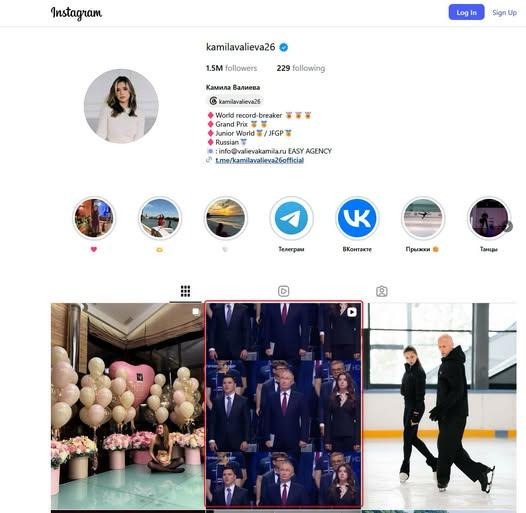
Figure 2: Kamila Valieva’s Instagram includes a pinned photo (center) of herself standing next to President Vladimir Putin at the Games of the Future on February 21, 2024 in Kazan. FS Gossips, “Kamila Valieva Has Been Granted Neutral Status for ISU International Competition,” Facebook post, June 2026, https://www.facebook.com/fsgossips/posts/kamila-valieva-has-been-granted-neutral-status-for-isu-international-competition/1455097509971994/.
Four days after the conclusion of the Beijing Olympics—during the duration of the Olympic Truce—Russian soldiers invaded Ukraine. The IOC suspended the Russian Olympic Committee, and the ISU likewise banned Russian and Belarussian skaters from international competition [17, 3]. Nearly two years later, CAS suspended Valieva from international competition due to her doping violation, with her ban backdated to her positive test. She would be free to compete again in December 2025 [2]. However, the ISU did not propose readmitting Russian and Belarusian skaters as “neutral athletes” until a half a year later, on the condition that athletes were:
a) not in active service with the armed forces or a national security agency of Russia or Belarus;
b) had not, at any time since February 2022, taken active part in military operations in the war against Ukraine; or
c) had not, at any time since February 2022, actively and publicly supported the war [18].
Valieva, like all other Russian athletes, was “presumed eligible” unless she were to be disqualified [18]. The Ukrainian Figure Skating Federation (UFSF) protested this decision in an open letter to ISU President Jae Youl Kim. The UFSF highlighted Valieva’s receipt of a state decoration from Vladimir Putin, her participation in the state-sponsored “Games of the Future,” her participation in a children’s and youth ideological organization founded by Putin, and her training at the figure skating academy of Tatiana Navka (herself subject to sanctions for “supporting actions which undermine or threaten the territorial integrity, sovereignty and independence of Ukraine”) [19]. Two weeks later, the ISU revoked Valieva’s neutral status [20].
The ECHR Complaint and the Future of Russian Figure Skating
Around the same time that Valieva lost neutral status, the ECHR registered and accepted her complaint of human rights violations during her CAS doping violation arbitration process. Valieva alleges that CAS did not adequately consider her age and status as a “protected person” under anti-doping laws, meted a disproportionately harsh punishment, questioned her without a lawyer present for two hours, and failed to present a rigorous review of her case before the Swiss Federal Supreme Court [1]. Because CAS is headquartered in Lausanne and its awards are reviewed through Swiss courts, a successful ECHR claim could result in compensation from Switzerland.
The United Nations Universal Declaration of Human Rights (UDHR) declares that all are entitled to a fair hearing, an impartial trial, and are innocent until proven guilty [21]. Human rights protections exist to protect controversial claimants as well as sympathetic ones. If the ECHR determines that Valieva’s human rights were indeed violated, she should be able to seek justice within available legal frameworks. At the same time, the ECHR case highlights the contrast between Valieva’s two legal identities. Before the ECHR, she appears primarily as an individual athlete entitled to procedural safeguards. Before the ISU, though, she appears as a public figure whose relationship with the Russian state threatens her eligibility to compete internationally.
The UDHR also states that individuals are entitled to life, liberty, and security. Due to Russian state aggression, Ukrainian skaters face material threats to their abilities to train, compete, and participate in sport at all. In mid-October 2026, a Russian missile damaged the Shalett Ice Arena, which serves as Ukrainian national skating team’s main training rink [22]. Although the Ukrainian Figure Skating Federation receives some financial support from the International Skating Union, how can it nurture the next generation of skating talent in an active war zone? [3] There remains a profound moral and political tension when a skater elevated as a symbol of Putin’s Russia could receive redress from a European human-rights court at the same time that Ukrainian athletes bear the consequences of the war waged by the state Valieva proudly represented.
Figure skating is not a human right, nor are human rights contingent on nationality or political virtue. Yet Kamila Valieva’s case resists simple categorization: she is an individual and a national symbol, an athlete sanctioned for a doping violation and a victim of the Russian sporting system. Valieva herself has hardly escaped unscathed. Her Olympic dreams ended in public collapse before a global audience. She lost her titles, served a lengthy suspension, and remains excluded from international competition under the ISU’s neutrality policies. Whatever compensation she might ultimately receive from the ECHR cannot restore the career she lost or erase the experience of becoming the public face of one of the most consequential scandals in modern Olympic sport. Perhaps this is the final irony: the same political and sporting system that transformed a gifted child athlete into a symbol of national prestige may have also helped destroy the very future it promised her.
(*) Sophie Cope is a Master’s Candidate of International Affairs: U.S. Foreign Policy and National Security at American University (2025-2026)
References
[1] Valieva v Switzerland and 7 Others. App no 3073/25. European Convention on Human Rights, August 20, 2026. https://hudoc.echr.coe.int/eng#{%22itemid%22:[%22001-252431%22]}.
[2] Russian Olympic Committee (ROC) v International Skating Union (ISU) CAS 2024/A/10355, Aleksandr Galliamov and Others v International Skating Union (ISU) CAS 2024/A/10356, Figure Skating Federation of Russia v International Skating Union (ISU) CAS 2024/A/10360. CAS Arbitral Award, May 12, 2025. https://www.tas-cas.org/generated/assets/lists/feb900ba-1137-4b78-a9ff-d68af7869087/CAS_10355-10356-10360_-_Final_Award__for_publ._.pdf.
[3] International Skating Union. “Communication No. 2469: Decisions of the ISU Council – War in Ukraine/Protective Measures.” April 25, 2022. https://isu-d8g8b4b7ece7aphs.a03.azurefd.net/isuproduction/uploads/images/decisionsoftheisucouncil/2469_Decisions_of_Council_meeting_April_24_2022.pdf.
[4] Rider, Toby C., and Matthew P. Llewellyn. “The Five Rings and the ‘Imagined Community’: Nationalism and the Modern Olympic Games.” The SAIS Review of International Affairs 35, no. 2 (2015): 21–32. https://www.jstor.org/stable/27000994.
[5] Oh, Chuyun. “Nationalizing the Balletic Body in Olympic Figure Skating.” In Sport in Korea, 1st ed., edited by Dae Hee Kwak, Yong Jae Ko, Inkyu Kang, and Mark Rosentraub, 119–32. Routledge, 2018. https://doi.org/10.4324/9781315229775-9
[6] Volkov, Andrey. “Ladies Figure Skating as an Element of Russian Soft Power in the International Arena.” Journal of Political Science and International Relations 4, no. 1 (2021): 1-7. doi: 10.11648/j.jpsir.20210401.11.
[7] McLaren, Richard H. The Independent Person 2nd Report. Montreal: World Anti-Doping Agency, 2016. https://www.wada-ama.org/sites/default/files/resources/files/mclaren_report_part_ii_2.pdf.
[8] “Olympics-Russia to compete under ROC acronym in Tokyo as part of doping sanctions.” Reuters, February 19, 2021. https://www.reuters.com/lifestyle/sports/olympics-russia-compete-under-roc-acronym-tokyo-part-doping-sanctions-2021-02-19/.
[9] Bieler, Des. “Putin Gives Award to Skater Kamila Valieva, Dismisses Role of PEDs.” The Washington Post, April 27, 2022. https://www.washingtonpost.com/sports/olympics/2022/04/27/putin-kamila-valieva-skating-award/.
[10] Court of Arbitration for Sport. International Olympic Committee (IOC) & World Anti-Doping Agency (WADA) & International Skating Union (ISU) v. Russian Anti-Doping Agency (RUSADA) & Kamila Valieva & Russian Olympic Committee (ROC), CAS OG 22/008, 22/009, and 22/010. Award of February 17, 2022 (operative part February 14, 2022). Lausanne: Court of Arbitration for Sport, 2022. https://jurisprudence.tas-cas.org/pdf/OG%2022-008,%20009,%20010.pdf.
[11] Brennan, Christine. “Kamila Valieva Was Failed by the Adults in Her Life – and It Showed in Olympic Meltdown | Opinion.” USA Today, February 17, 2022. https://www.usatoday.com/story/sports/columnist/brennan/2022/02/17/kamila-valieva-figure-skating-russia-long-program/6829008001/?gnt-cfr=1&gca-cat=p.
[12] Russian Ministry of Defense (@mod_russia). “#Video Cadets of the Stavropol Presidential Cadet School (PKU) joined the #KamilaWeAreWithYou flash mob in support of Russian figure skater Kamila Valieva. #MinistryOfDefense #StavropolPKU #KamilaWeAreWithYou.” X, February 17, 2022, https://x.com/mod_russia/status/1494304905686835202?s=20&t=QClWFKkNsL-ZKoBwlw0A_Q
[13] Burke, Patrick. “Valieva awarded Order of Friendship in Russia.” Inside the Games, February 26, 2022. https://www.insidethegames.biz/articles/valieva-order-of-friendship-award.
[14] “Putin says Valieva’s skating ‘perfection’ could not be achieved with doping.” Reuters, April 26, 2022. https://www.reuters.com/lifestyle/sports/putin-says-valievas-figure-skating-performances-could-not-be-achieved-with-2022-04-26/.
[15] Dunbar, Graham. “Israel’s Olympic status not in question says IOC president Bach amid frustration with Russia.” AP News, March 6, 2024. https://apnews.com/article/paris-olympics-ioc-bach-israel-russia-8b6005213cb0e680bf533c0454ece216.
[16] FS Gossips. “Kamila Valieva Has Been Granted Neutral Status for ISU International Competition.” Facebook post, August 7, 2026. Facebook. https://www.facebook.com/fsgossips/posts/kamila-valieva-has-been-granted-neutral-status-for-isu-international-competition/1455097509971994/.
[17] Dunbar, Graham. “IOC suspends Russian Olympic Committee for incorporating Ukrainian sports regions.” AP News, October 12, 2023. https://apnews.com/article/ioc-olympics-russia-suspended-ukraine-0c67668922b0262fbe358e6343b71d0e.
[18] International Skating Union. “ISU Communication No. 2804: On the Adaptation of Protective Measures concerning Skaters and Support Personnel affiliated with the ISU Members in Russia and Belarus – Readmission of Neutral Athletes.” June 30, 2026. https://isu-d8g8b4b7ece7aphs.a03.azurefd.net/isudamcontainer/CMS/Corporate-Site/Governance/Transparency/ISU-Communications/2804-Readmission-Neutral-Athletes-RUS-BLR—Acknowledgement-Form-1782804763-7382.pdf.
[19] Ukrainian Figure Skating Federation. “Open Letter.” August 28, 2026. https://www.ukrfsf.org.ua/wp-content/uploads/2026/09/ufsf-open-letter-with-annex-28-august-2026.pdf.
[20] International Skating Union. “ISU Update on AIN Eligibility.” October 9, 2026. https://www.isu.org/en/news/isu-update-on-ain-eligibility.
[21] UN General Assembly. Resolution 217 (III) A, “Universal Declaration of Human Rights,” A/RES/217(III), December 10, 1948. https://www.un.org/en/about-us/universal-declaration-of-human-rights.
[22] “Video: Russia Damaged the Ukrainian National Figure Skating Team’s Arena in Kyiv.” UA News, October 19, 2026. https://ua.news/en/war-vs-rf/video-rosiia-poshkodila-arenu-zbirnoyi-ukrayini-z-figurnogo-katannia-v-kiievi.